Introduction
The way people discover and choose businesses has changed dramatically. A few years ago, people mainly depended on newspapers, television, banners, referrals, and traditional advertisements to find products and services. Today, most people start their search online.
Whether someone wants to find a restaurant, buy a phone, hire an interior designer, book a hotel, or choose a digital marketing agency, there is a good chance they will search online first.
This is where digital marketing comes in.
In simple words, digital marketing means promoting a business, product, or service using the internet and digital channels. These channels can include Google, social media platforms, websites, email, search engines, online advertisements, and more.
For businesses, digital marketing is no longer just an additional marketing option. It has become an important part of reaching potential customers.
What Exactly Is Digital Marketing?
Digital marketing is the process of using digital platforms to reach, attract, engage, and convert potential customers.
For example, imagine that you own an interior design company in Kolkata.
A person searches Google for “best interior designer near me.” If your website appears in the search results, that is digital marketing.
If the same person sees your interior design advertisement on Instagram, that is also digital marketing.
If they receive an email from your company offering a consultation, that is digital marketing too.
So, digital marketing covers many different activities rather than being a single marketing method.
Major Types of Digital Marketing
There are several important areas of digital marketing.
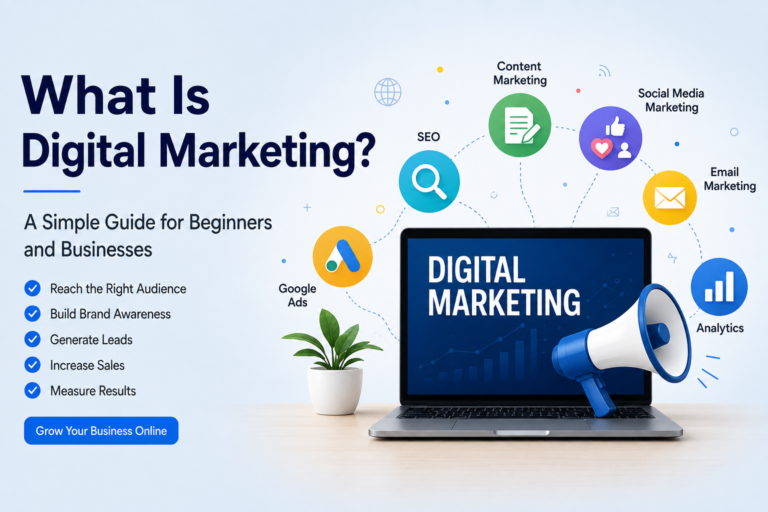
1. Search Engine Optimization (SEO)
SEO helps a website appear higher in search engine results organically, without paying for every click.
For example, if you provide website development services and your website ranks for “website development company in Kolkata,” people can discover your business through Google.
SEO generally involves content, keywords, technical improvements, website structure, backlinks, and user experience.
2. Google Ads
Google Ads allows businesses to advertise on Google’s search results and other Google properties.
Suppose someone searches for “Google Ads agency near me.” A business can run an advertisement that appears when people search for relevant terms.
The major advantage is that businesses can reach people who are already showing interest in a particular product or service.
3. Social Media Marketing
Platforms such as Facebook, Instagram, LinkedIn, and YouTube allow businesses to connect with their audiences.
Social media marketing can include organic posts, videos, reels, educational content, community engagement, and paid advertising.
It is particularly useful for building awareness, trust, engagement, and brand recognition.
4. Content Marketing
Content marketing means creating useful information that attracts and educates potential customers.
Examples include blogs, videos, guides, infographics, case studies, and social media posts.
Instead of simply saying “buy our service,” content marketing answers the questions customers have before making a purchase.
5. Email Marketing
Email marketing involves communicating with customers and prospects through email.
Businesses can use email to share offers, newsletters, product updates, educational content, and important information.
6. Performance Marketing
Performance marketing focuses strongly on measurable results such as leads, sales, conversions, or revenue.
For example, instead of simply measuring how many people saw an advertisement, a business may focus on how many qualified leads were generated from that advertisement.
Why Is Digital Marketing Important?
One of the biggest advantages of digital marketing is reach.
A local business can reach people in its city, while an ecommerce company can reach customers across the country or even internationally.
Digital marketing also allows businesses to understand their audiences better.
For example, advertising platforms can provide information about impressions, clicks, conversions, cost per lead, and other performance metrics.
This information helps businesses understand what is working and what needs improvement.
Another advantage is flexibility.
Traditional advertising can sometimes require a significant upfront investment. Digital campaigns can often be started with smaller budgets and adjusted based on performance.
Digital Marketing Is Not Just About Advertising
A common misunderstanding is that digital marketing simply means running advertisements.
Advertising is only one part of digital marketing.
A successful digital marketing strategy may include SEO, content, social media, Google Ads, Meta Ads, email marketing, website optimization, and conversion optimization.
Imagine a customer sees your Instagram advertisement but does not purchase immediately. Later, they search your company on Google and visit your website.
They read your blog, check your reviews, look at your services, and finally contact you.
Several digital marketing activities may have contributed to that single customer.
How Does Digital Marketing Help a Business?
Digital marketing can help businesses:
- Increase online visibility
- Generate leads
- Increase website traffic
- Build brand awareness
- Reach specific audiences
- Generate sales
- Improve customer engagement
- Understand customer behaviour
- Build long-term relationships
- Measure marketing performance
However, digital marketing does not guarantee success simply because a business is present online.
Strategy matters.
A business needs the right audience, the right message, the right platform, good creative content, a useful website, and proper measurement.
Digital Marketing for Small Businesses
Digital marketing is especially valuable for small businesses.
A small business does not necessarily need to compete with a large company by spending more money. Instead, it can focus on a specific audience or location.
For example, a local dentist could target people searching for dental services within a particular city or area.
An interior designer could showcase completed projects through Instagram while using Google Ads to target people actively searching for interior design services.
The key is to understand where potential customers spend their time and what they are looking for.
Final Thoughts
Digital marketing is essentially about meeting customers where they already spend their time — online.
It combines different strategies such as SEO, Google Ads, social media, content marketing, email marketing, and performance marketing to help businesses attract and convert customers.
The best digital marketing strategy is not necessarily the one using the most platforms. It is the one that understands the target audience and uses the right channels to achieve specific business goals.
For a business owner, the most important question is not simply, “Should I do digital marketing?”
The better question is:
“Which digital marketing strategy can help my business reach the right customers and achieve measurable growth?”
That is where a well-planned digital marketing strategy can make a real difference.