Introduction
Digital marketing and performance marketing are terms that are often used interchangeably.
Many business owners hear both terms and wonder whether they mean the same thing.
They are closely related, but they are not identical.
The easiest way to understand the difference is this:
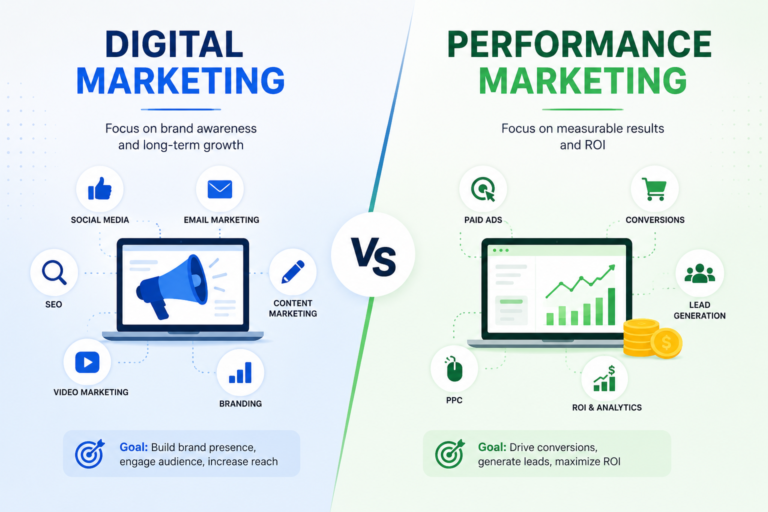
Digital marketing is the bigger umbrella. Performance marketing is a results-focused approach within digital marketing.
Understanding this difference can help businesses choose the right strategy for their goals.
What Is Digital Marketing?
Digital marketing refers to marketing activities performed through digital channels.
These can include:
- SEO
- Google Ads
- Meta Ads
- Social media marketing
- Content marketing
- Email marketing
- Influencer marketing
- Video marketing
- Website marketing
- Online reputation management
The objective can vary.
A business might use digital marketing to build awareness, increase website traffic, generate leads, improve brand visibility, or increase sales.
What Is Performance Marketing?
Performance marketing focuses strongly on measurable actions.
These actions could include:
- Leads
- Purchases
- App installs
- Sign-ups
- Bookings
- Calls
- Form submissions
- Revenue
For example, a company running Google Ads may monitor how many enquiries are generated and how much each enquiry costs.
That is a performance marketing approach.
The Main Difference
The key difference is scope and focus.
Digital marketing is a broad field.
Performance marketing is more focused on measurable performance and business outcomes.
Think of digital marketing as a large toolbox.
Inside that toolbox are different tools such as SEO, social media, content marketing, Google Ads, and Meta Ads.
Performance marketing is more like a method of using some of those tools with strong emphasis on measurable results.
Simple Example
Imagine you own a restaurant.
You create Instagram posts showing your food.
You publish blogs about your menu.
You improve your Google Business Profile.
You create videos for YouTube.
You run Google Ads.
All of these can be part of your digital marketing strategy.
Now suppose you run an advertising campaign specifically to generate table reservations.
You track:
- Ad spend
- Reservations
- Cost per reservation
- Revenue
- Return on advertising spend
That campaign is being managed from a performance marketing perspective.
Difference in Goals
Digital marketing may have several goals.
For example:
- Build awareness
- Improve online visibility
- Increase organic traffic
- Build an audience
- Strengthen brand reputation
- Generate leads
- Increase sales
Performance marketing generally gives greater priority to measurable actions.
For example:
- Generate 100 leads
- Reduce cost per lead
- Increase purchases
- Improve conversion rate
- Increase revenue
- Improve ROAS
Difference in Measurement
Measurement is one of the biggest differences.
Digital marketing can include metrics such as website traffic, followers, engagement, impressions, search rankings, and brand reach.
These metrics can be valuable.
However, performance marketing typically connects metrics more directly with conversions and business outcomes.
For example, getting 100,000 impressions sounds good.
But if the campaign produces no enquiries or sales, the business may not consider it successful.
Does Digital Marketing Focus on Branding?
Yes.
Digital marketing can be strongly focused on branding.
For example, a company may create educational content for several months to establish expertise.
The immediate return may not be easy to measure.
But the content can build trust and recognition over time.
Performance marketing, on the other hand, usually places stronger emphasis on measurable actions.
This does not mean performance marketing ignores branding.
In reality, strong branding can improve advertising performance because people are more likely to trust businesses they recognize.
Which One Is Better?
There is no universal winner.
It depends on the business objective.
If a new company wants to establish itself in the market, a broader digital marketing strategy may be useful.
If a company wants immediate lead generation or ecommerce sales, performance marketing may receive greater priority.
In many cases, the best approach is to use both.
Digital Marketing and Performance Marketing Can Work Together
Consider an interior design company.
The company can use SEO to rank for relevant searches.
It can publish blogs about home interiors.
It can showcase projects on Instagram.
It can create videos.
At the same time, it can run Google Ads and Meta Ads to generate enquiries.
The organic activities build visibility and trust.
The paid campaigns can generate measurable opportunities.
Together, they create a stronger marketing ecosystem.
Common Misunderstanding
One common mistake is assuming that performance marketing means “getting cheap leads.”
Cheap leads are not necessarily good leads.
Suppose one campaign generates leads at ₹200 each, but most leads are irrelevant.
Another campaign generates leads at ₹600 each, but those leads regularly become paying customers.
The second campaign may actually be more valuable.
Therefore, businesses should measure the quality and value of conversions, not just the cost.
When Should a Business Use Digital Marketing?
Digital marketing is useful for businesses that want to build a sustainable online presence.
It is particularly valuable for:
- Brand building
- Organic growth
- Customer education
- Search visibility
- Social media presence
- Content distribution
- Long-term customer relationships
When Should a Business Focus on Performance Marketing?
Performance marketing can be particularly useful when a business has a clear measurable objective.
Examples include:
- Lead generation
- Ecommerce sales
- Appointment bookings
- Demo requests
- Calls
- Sign-ups
It works especially well when proper conversion tracking is available.
Final Thoughts
Digital marketing and performance marketing should not be viewed as competitors.
Digital marketing is the broader discipline, while performance marketing is a results-oriented approach that operates largely within it.
A successful business may need both.
Digital marketing helps build visibility, trust, and presence. Performance marketing helps turn marketing activity into measurable actions and business results.
The right balance depends on your business model, target audience, budget, competition, and objectives.