Introduction
People spend a significant amount of time on social media every day.
They watch videos, scroll through posts, discover products, follow brands, and interact with businesses.
For companies, platforms such as Facebook and Instagram provide an opportunity to reach potential customers through targeted advertising.
These advertisements are commonly known as Meta Ads.
What Are Meta Ads?
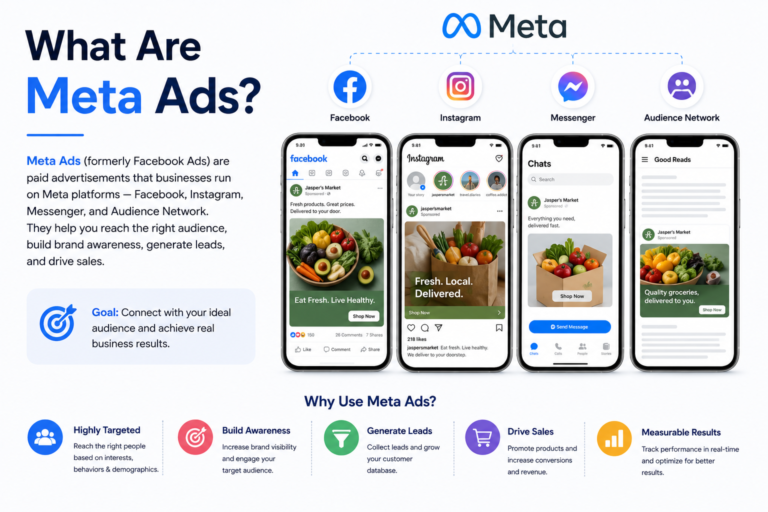
Meta Ads are paid advertisements delivered through Meta’s advertising ecosystem, including platforms such as Facebook and Instagram.
Businesses can use Meta’s advertising tools to promote products, services, content, offers, and brands.
Unlike search advertising, where a person actively searches for something, social media advertising can introduce an offer while people are browsing their feeds.
How Are Meta Ads Different From Google Ads?
The biggest difference is often user intent.
On Google, someone may search:
“buy running shoes”
That person is actively looking for running shoes.
On Instagram, someone may be scrolling through their feed when they see a running shoe advertisement.
They may not have been searching for shoes at that exact moment.
This makes Meta Ads useful not only for capturing existing demand but also for creating interest and reaching new audiences.
Why Do Businesses Use Meta Ads?
Meta Ads can help businesses:
- Generate leads
- Promote products
- Increase website traffic
- Build awareness
- Generate purchases
- Promote offers
- Retarget visitors
- Reach specific audiences
- Test different creative ideas
Meta’s visual nature also makes it particularly useful for businesses where images and videos influence purchasing decisions.
Examples include fashion, beauty, restaurants, fitness, real estate, interior design, ecommerce, education, and many other industries.
The Importance of Creative
Creative is extremely important in Meta advertising.
A user is usually scrolling quickly.
The advertisement has only a short opportunity to capture attention.
Good creative should communicate the main idea quickly.
It might use:
- A strong image
- Short-form video
- Demonstration
- Customer testimonial
- Before-and-after presentation
- Problem-and-solution format
- Offer-focused creative
For example, an interior designer could show a transformation from an empty room to a completed interior.
The visual itself can communicate the value of the service.
Audience Targeting
Meta Ads provide businesses with different ways to reach audiences.
Depending on the campaign and available data, businesses can use audience characteristics, interests, behaviours, customer lists, website activity, and other targeting approaches.
Businesses can also use retargeting to reach people who have previously interacted with their brand.
For example, someone may visit an ecommerce website without buying anything.
A business may later show that person another advertisement reminding them about the product.
What Is Retargeting?
Retargeting means advertising to people who have already interacted with your business.
They may have:
- Visited your website
- Viewed a product
- Watched a video
- Engaged with your social media
- Added an item to a cart
- Submitted information
Retargeting can be useful because these people have already shown some level of interest.
Meta Ads for Lead Generation
Meta Ads can be useful for service businesses that need enquiries.
For example, a real estate company could run a campaign promoting a new property project.
An interested person can submit their details through an appropriate lead-generation setup.
The business can then contact the prospect.
However, generating a lead is only the first step.
The business still needs a good sales process to qualify and convert that lead.
Measuring Meta Ads Performance
Businesses can track several metrics, depending on the campaign objective.
These can include:
- Impressions
- Reach
- Clicks
- Cost per click
- Leads
- Cost per lead
- Purchases
- Conversion rate
- Return on ad spend
Again, the cheapest metric is not always the best metric.
A campaign generating inexpensive but low-quality leads may perform worse for the business than a campaign generating more expensive but highly qualified leads.
Meta Ads Budget
The right budget depends on the business and its goals.
A local business may start with a relatively controlled test budget.
An ecommerce company operating across multiple markets may require a much larger budget.
The important point is to have enough data to evaluate campaign performance while controlling unnecessary spending.
Common Meta Ads Mistakes
Businesses often make mistakes such as:
- Using weak creatives
- Targeting audiences without testing
- Running one advertisement for too long
- Failing to test different messages
- Poor landing pages
- Weak offers
- Incorrect tracking
- Focusing only on likes and comments
- Ignoring lead quality
Meta Ads should be treated as a performance system rather than simply a social media post with money behind it.
Meta Ads and Branding
One of the strengths of Meta Ads is that they can combine performance and branding.
A well-designed advertisement can generate a lead while also introducing the brand to a potential customer.
Repeated exposure can help businesses become familiar to their target audience.
This is particularly useful for products or services where customers need time before making a decision.
Final Thoughts
Meta Ads provide businesses with a powerful way to reach potential customers on platforms such as Facebook and Instagram.
Their strength lies in visual communication, audience targeting, creative testing, and the ability to reach people before they necessarily search for a product or service.
However, successful Meta advertising requires more than simply boosting a post.
Businesses need strong creative, a relevant offer, appropriate targeting, proper tracking, a good landing experience, and continuous optimization.
The objective is not simply to reach more people. It is to reach the right people with the right message at the right time.