Introduction
Every business wants results from its marketing.
Getting thousands of views or impressions may look impressive, but business owners usually want something more meaningful: enquiries, leads, sales, customers, and revenue.
This is where performance marketing becomes important.
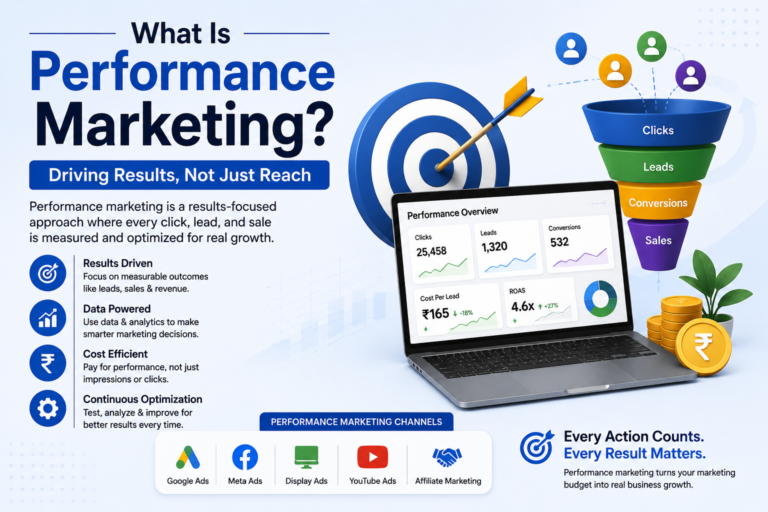
In simple terms, performance marketing is a form of digital marketing where campaigns are planned, tracked, and optimized around measurable actions.
Instead of focusing only on visibility, performance marketing asks a more practical question:
“What did the marketing campaign actually achieve?”
What Is Performance Marketing?
Performance marketing is a results-focused approach to online marketing.
The desired result can be different depending on the business.
For an interior designer, the goal might be qualified enquiries.
For an ecommerce company, the goal might be purchases.
For a software company, it could be free trials or demo bookings.
For a coaching business, it might be consultation bookings.
Therefore, performance marketing is not about one specific platform. It is about measuring marketing activity against business outcomes.
How Does Performance Marketing Work?
Let’s take a simple example.
Suppose a real estate company spends ₹50,000 on online advertising.
During the campaign, the company receives 200 enquiries.
The marketing team can then analyse:
- How much was spent?
- How many leads were generated?
- What was the cost per lead?
- How many leads were qualified?
- How many sales were generated?
- What revenue came from the campaign?
This information helps the business understand whether the campaign is actually contributing to growth.
Common Performance Marketing Channels
Performance marketing can use several digital channels.
Google Ads
Google Ads is one of the most popular performance marketing channels.
Businesses can target people searching for specific products and services.
For example, someone searching for “best digital marketing agency in Kolkata” already has some level of intent.
A relevant advertisement can put a business in front of that potential customer at the right moment.
Meta Ads
Meta Ads can help businesses reach people through platforms such as Facebook and Instagram.
Businesses can target audiences based on various characteristics and campaign objectives.
Meta Ads can be particularly useful for generating demand, promoting products, collecting leads, and remarketing.
Display Advertising
Display campaigns use visual advertisements across websites and digital properties.
They can be useful for awareness, remarketing, and reaching relevant audiences.
Affiliate Marketing
In affiliate marketing, partners promote a business’s products or services and receive compensation based on agreed results.
This can create a performance-oriented relationship between the advertiser and the affiliate.
Important Performance Marketing Metrics
Performance marketing relies heavily on data.
Some common metrics include:
Cost Per Click (CPC)
CPC tells you how much you are paying, on average, for a click.
Cost Per Lead (CPL)
CPL tells you how much it costs to generate a lead.
Conversion Rate
Conversion rate shows the percentage of users who complete a desired action.
Return on Ad Spend (ROAS)
ROAS compares revenue generated from advertising with advertising expenditure.
For example, if a business spends ₹10,000 on advertising and generates ₹40,000 in tracked revenue, the ROAS is 4x.
However, revenue alone does not always tell the complete story because profit margins, operational costs, and customer lifetime value also matter.
Why Is Performance Marketing Important?
One major benefit is accountability.
Businesses can track campaigns and make decisions based on data instead of assumptions.
Suppose Campaign A generates leads at ₹300 each while Campaign B generates leads at ₹800 each.
At first glance, Campaign A appears better.
But what if Campaign B produces much higher-quality leads that convert into customers more frequently?
This is why performance marketing should not focus on one metric alone.
The real goal is to connect marketing data with business results.
Performance Marketing vs Traditional Advertising
Traditional advertising often focuses on exposure.
For example, a billboard may be seen by thousands of people, but measuring exactly how many viewers became customers can be difficult.
Digital performance marketing offers much more detailed tracking.
Businesses can often see impressions, clicks, conversions, costs, and other campaign data.
This does not mean traditional advertising is ineffective. It simply means performance marketing provides a different level of measurability.
Is Performance Marketing the Same as Digital Marketing?
No.
Performance marketing is a part of the larger digital marketing ecosystem.
Digital marketing can include SEO, content marketing, branding, social media, email marketing, websites, paid advertising, and more.
Performance marketing puts greater emphasis on measurable actions and outcomes.
A company may use digital marketing to build its brand while using performance marketing to generate leads and sales.
Both can work together.
The Importance of Landing Pages
Advertising alone does not guarantee results.
Imagine a business receives 1,000 clicks from an advertisement but has a confusing website.
Visitors may leave without contacting the company.
This is why landing pages are important in performance marketing.
A good landing page should clearly communicate:
- What the business offers
- Why the customer should care
- What makes the offer different
- Why the customer should trust the business
- What action they should take next
The advertisement gets the visitor’s attention. The landing page helps convert that attention into action.
Performance Marketing Requires Continuous Optimization
A campaign should not simply be launched and forgotten.
Marketers should regularly analyse the data.
They may test different:
- Audiences
- Headlines
- Images
- Videos
- Offers
- Landing pages
- Keywords
- Calls to action
- Campaign structures
Small improvements can sometimes make a meaningful difference in campaign performance.
Final Thoughts
Performance marketing is about making marketing more measurable and accountable.
Instead of asking only how many people saw an advertisement, businesses can ask how many people clicked, submitted an enquiry, purchased, or became customers.
However, performance marketing is not a magic formula.
Good results require the right strategy, targeting, creative, offer, landing page, tracking, and continuous optimization.
The ultimate objective is not simply to generate cheap clicks or cheap leads.
The objective is to generate valuable business results.