Blogs

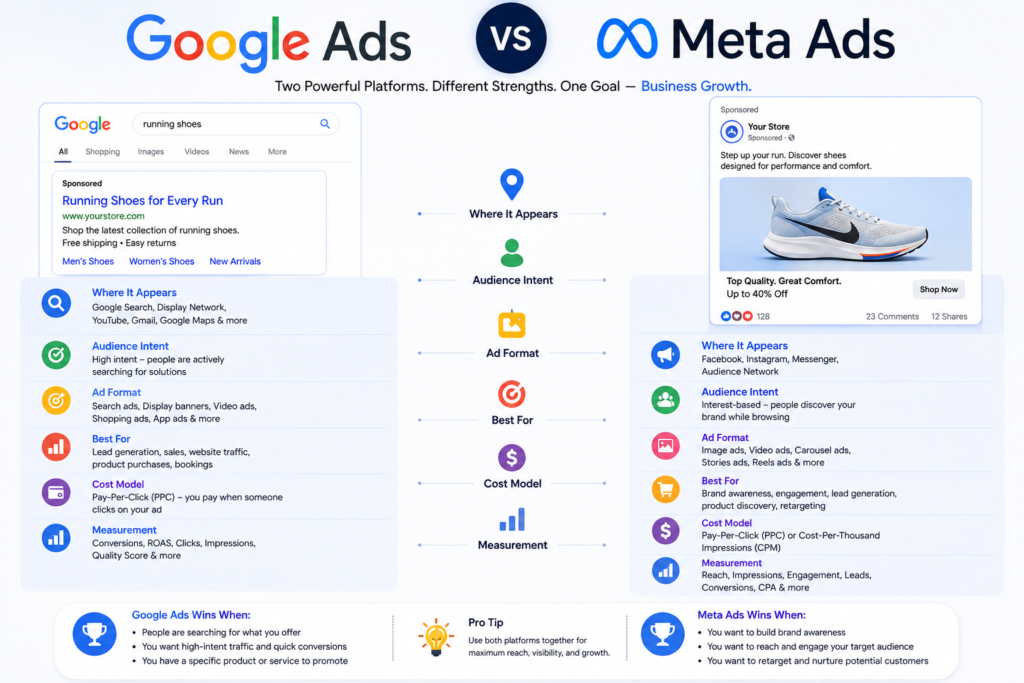
Google Ads vs Meta Ads: Which Advertising Platform Is Better for Your Business?

Introduction One of the most common questions business owners ask is: “Should I run Google Ads or Meta Ads?” The answer is not as simple as choosing one platform. Both platforms can be highly useful, but they work differently. Google Ads is often strongest when people are actively searching for a product or service. Meta Ads can be powerful for discovering and reaching potential customers while they are browsing platforms such as Facebook and Instagram. Understanding this difference can help businesses decide where to invest their advertising budget. Google Ads: Capturing Existing Demand Google Ads is particularly useful when people already know what they want. Consider someone searching: “best dentist near me” “buy office chair online” “Google Ads agency in Kolkata” “AC repair service near me” These searches indicate an existing need. Google Ads allows businesses to appear when relevant searches happen. This is why search advertising can be particularly effective for businesses offering services that people actively search for. Meta Ads: Creating and Generating Demand Meta Ads work differently. People generally open Instagram or Facebook to browse content rather than specifically search for a product. They may discover an advertisement while scrolling. For example, someone might see a video of a beautifully renovated home from an interior design company. They were not necessarily searching for an interior designer five seconds earlier. But the creative may create interest. They might click the advertisement, visit the website, follow the company, or submit an enquiry. This is one of the key strengths of Meta advertising. Google Ads vs Meta Ads Factor Google Ads Meta Ads Main strength Capturing existing demand Creating and developing demand User behaviour Actively searching Browsing social content Major platforms Google Search and Google properties Facebook and Instagram Creative importance Important Extremely important Search intent Usually stronger Usually less direct Visual storytelling Useful Very important Lead generation Strong for high-intent searches Strong with good creative and targeting Ecommerce Strong Strong Local services Often highly effective Can also work well Brand awareness Useful Very useful Retargeting Available Very useful Which Platform Is Better for Lead Generation? It depends on the business. Suppose you are a lawyer, dentist, plumber, or digital marketing agency. Potential customers may actively search for your services. In such cases, Google Ads can be highly useful because the advertisement appears when demand already exists. Now consider a fashion brand. A customer may not search for a specific new clothing brand. A visually attractive Instagram advertisement could introduce the product and encourage the customer to visit the website. Meta Ads may therefore be very useful. Which Platform Is Better for Ecommerce? Both can work well. Google Ads can capture people searching for specific products. Meta Ads can introduce products through engaging images and videos and can also support retargeting. An ecommerce business may benefit from using both platforms instead of relying entirely on one. Which Platform Is Better for Brand Awareness? Meta Ads can be particularly effective for visual brand awareness because people naturally consume images and videos on social platforms. However, Google advertising can also contribute to brand visibility. The best choice depends on the audience, creative assets, product, and campaign objective. Can Google Ads and Meta Ads Be Used Together? Absolutely. In fact, using both can create a stronger customer journey. Imagine someone sees your Meta advertisement on Instagram. They become interested but do not contact you immediately. Later, they search your company name on Google. They find your website and eventually submit an enquiry. The first interaction may have happened on Meta, while the final conversion may have happened through Google or direct traffic. This is why businesses should avoid judging each channel completely in isolation. A Simple Strategy for Businesses A business can divide its advertising strategy according to customer intent. Use Google Ads When: Use Meta Ads When: Why Creative Matters More on Meta On Google Search, the user has already typed a search query. The advertisement needs to be relevant and persuasive. On Meta, the user may not be looking for your product at all. Therefore, the advertisement itself has to stop the scroll. This makes creative strategy particularly important. The first few seconds of a video or the first visual impression can determine whether someone continues watching or scrolls past. Why Keywords Matter More on Google Google Search advertising depends heavily on understanding what people search for. Businesses need to identify relevant search terms and understand the intent behind those searches. For example: “what is digital marketing?” and “digital marketing agency” may relate to the same broad topic, but the commercial intent is very different. Keyword research and campaign structure therefore play a major role in Google Ads. Which One Costs Less? There is no universal answer. Advertising costs vary based on industry, competition, location, audience, campaign setup, creative quality, landing page experience, and many other factors. More importantly, businesses should not choose a platform simply because its CPC or CPL appears lower. A ₹300 lead is not necessarily better than a ₹600 lead. If the ₹600 lead is much more likely to become a paying customer, it could provide greater business value. The Best Platform Is the One That Produces Business Results Businesses sometimes become too focused on platform metrics. They compare: “Google gives leads at ₹500.” “Meta gives leads at ₹300.” But the better question is: “Which platform generates more qualified customers and profitable revenue?” A proper evaluation should consider: Final Thoughts Google Ads and Meta Ads are not necessarily competitors. They solve different parts of the customer journey. Google Ads is excellent at capturing existing demand. Meta Ads is excellent at creating attention, generating interest, and reaching potential customers through visual content. For many businesses, the strongest strategy is not choosing between Google and Meta but using both intelligently. Google can capture people who are actively looking. Meta can reach people who may need your product or service but have not started searching yet. When combined with strong landing pages, proper tracking, compelling offers, good creative, and

Google Ads vs Meta Ads: Which Advertising Platform Is Better for Your Business? Read Post »
Blogs

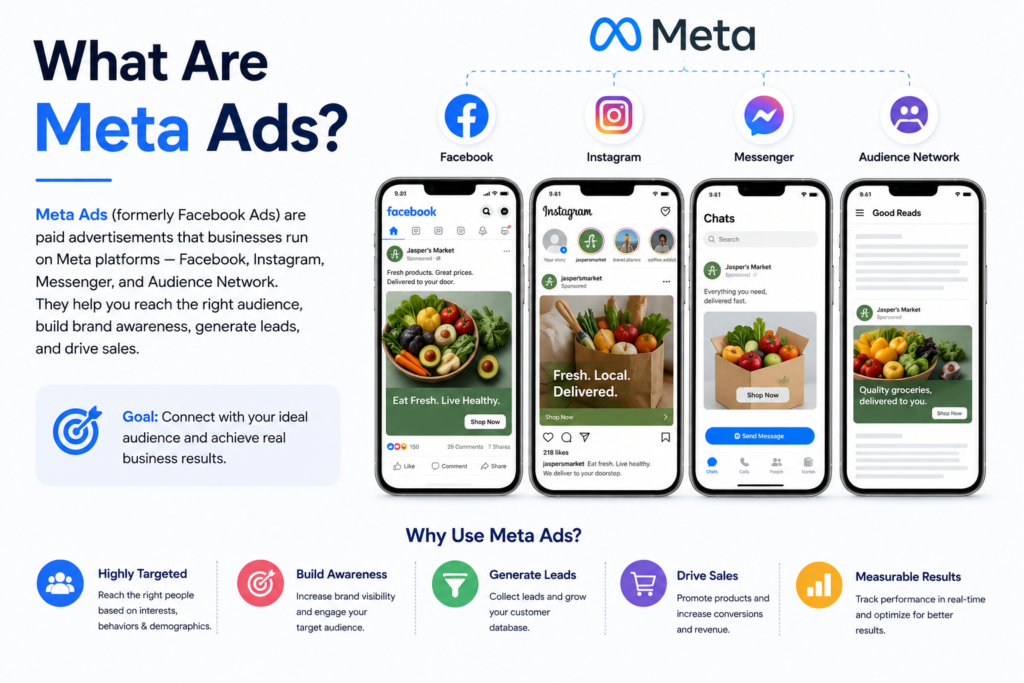
What Are Meta Ads? A Simple Guide to Facebook and Instagram Advertising

Introduction People spend a significant amount of time on social media every day. They watch videos, scroll through posts, discover products, follow brands, and interact with businesses. For companies, platforms such as Facebook and Instagram provide an opportunity to reach potential customers through targeted advertising. These advertisements are commonly known as Meta Ads. What Are Meta Ads? Meta Ads are paid advertisements delivered through Meta’s advertising ecosystem, including platforms such as Facebook and Instagram. Businesses can use Meta’s advertising tools to promote products, services, content, offers, and brands. Unlike search advertising, where a person actively searches for something, social media advertising can introduce an offer while people are browsing their feeds. How Are Meta Ads Different From Google Ads? The biggest difference is often user intent. On Google, someone may search: “buy running shoes” That person is actively looking for running shoes. On Instagram, someone may be scrolling through their feed when they see a running shoe advertisement. They may not have been searching for shoes at that exact moment. This makes Meta Ads useful not only for capturing existing demand but also for creating interest and reaching new audiences. Why Do Businesses Use Meta Ads? Meta Ads can help businesses: Meta’s visual nature also makes it particularly useful for businesses where images and videos influence purchasing decisions. Examples include fashion, beauty, restaurants, fitness, real estate, interior design, ecommerce, education, and many other industries. The Importance of Creative Creative is extremely important in Meta advertising. A user is usually scrolling quickly. The advertisement has only a short opportunity to capture attention. Good creative should communicate the main idea quickly. It might use: For example, an interior designer could show a transformation from an empty room to a completed interior. The visual itself can communicate the value of the service. Audience Targeting Meta Ads provide businesses with different ways to reach audiences. Depending on the campaign and available data, businesses can use audience characteristics, interests, behaviours, customer lists, website activity, and other targeting approaches. Businesses can also use retargeting to reach people who have previously interacted with their brand. For example, someone may visit an ecommerce website without buying anything. A business may later show that person another advertisement reminding them about the product. What Is Retargeting? Retargeting means advertising to people who have already interacted with your business. They may have: Retargeting can be useful because these people have already shown some level of interest. Meta Ads for Lead Generation Meta Ads can be useful for service businesses that need enquiries. For example, a real estate company could run a campaign promoting a new property project. An interested person can submit their details through an appropriate lead-generation setup. The business can then contact the prospect. However, generating a lead is only the first step. The business still needs a good sales process to qualify and convert that lead. Measuring Meta Ads Performance Businesses can track several metrics, depending on the campaign objective. These can include: Again, the cheapest metric is not always the best metric. A campaign generating inexpensive but low-quality leads may perform worse for the business than a campaign generating more expensive but highly qualified leads. Meta Ads Budget The right budget depends on the business and its goals. A local business may start with a relatively controlled test budget. An ecommerce company operating across multiple markets may require a much larger budget. The important point is to have enough data to evaluate campaign performance while controlling unnecessary spending. Common Meta Ads Mistakes Businesses often make mistakes such as: Meta Ads should be treated as a performance system rather than simply a social media post with money behind it. Meta Ads and Branding One of the strengths of Meta Ads is that they can combine performance and branding. A well-designed advertisement can generate a lead while also introducing the brand to a potential customer. Repeated exposure can help businesses become familiar to their target audience. This is particularly useful for products or services where customers need time before making a decision. Final Thoughts Meta Ads provide businesses with a powerful way to reach potential customers on platforms such as Facebook and Instagram. Their strength lies in visual communication, audience targeting, creative testing, and the ability to reach people before they necessarily search for a product or service. However, successful Meta advertising requires more than simply boosting a post. Businesses need strong creative, a relevant offer, appropriate targeting, proper tracking, a good landing experience, and continuous optimization. The objective is not simply to reach more people. It is to reach the right people with the right message at the right time.

What Are Meta Ads? A Simple Guide to Facebook and Instagram Advertising Read Post »

Blogs

What Are Google Ads? A Complete Beginner’s Guide for Businesses

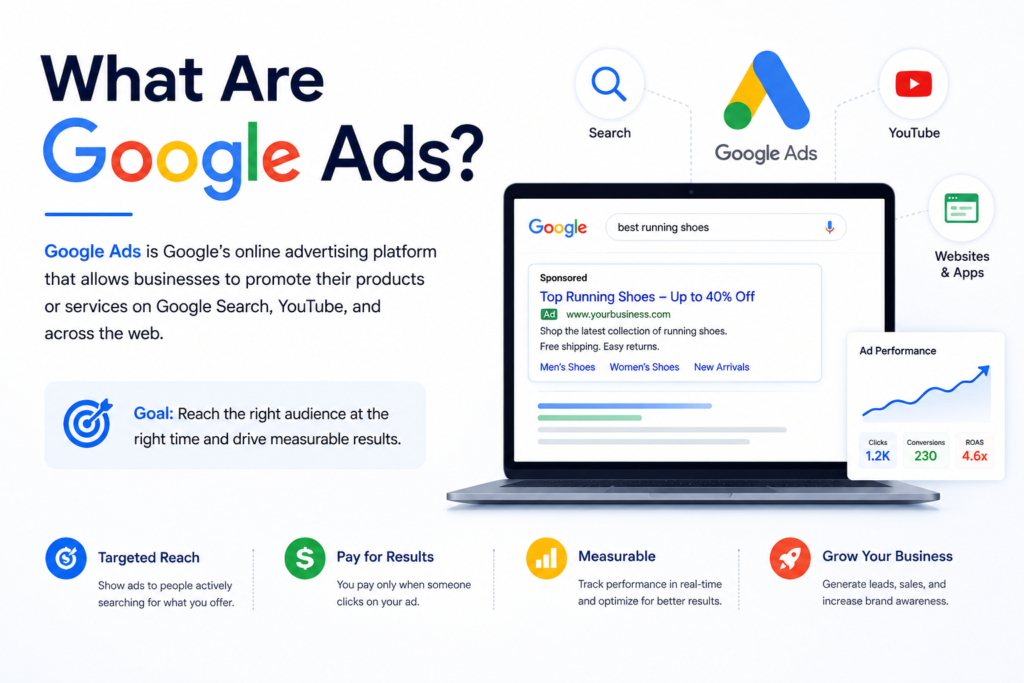
Introduction Imagine someone needs a service right now. They open Google and search: “best digital marketing agency near me” “Google Ads agency in Kolkata” “best interior designer in Kolkata” “dentist near me” At that moment, the person is actively looking for a solution. Google Ads gives businesses an opportunity to appear in front of people during these important moments. What Are Google Ads? Google Ads is Google’s online advertising platform. Businesses can use it to promote products and services across Google’s advertising network. One of the most well-known formats is search advertising, where ads can appear when users search for relevant terms. For example, if someone searches for “Google Ads agency,” a business offering Google Ads services may run an advertisement targeting relevant keywords. How Does Google Ads Work? Google Ads operates through an auction system. Businesses choose keywords, audiences, locations, budgets, and other campaign settings. When a user performs a relevant search, eligible advertisements compete for available advertising positions. The outcome depends on multiple factors, including the bid and the quality and relevance of the advertisement and landing page. This means the business willing to pay the most does not automatically win every time. Why Do Businesses Use Google Ads? One major advantage of Google Ads is intent. People searching for a particular service often have an existing need. For example, someone searching for “AC repair near me” is likely looking for an AC repair service. This can make search advertising especially useful for businesses offering products or services people actively search for. Google Ads can help businesses: Types of Google Ads Campaigns Google offers different advertising campaign types. Search Ads These advertisements can appear on search engine results pages for relevant searches. They are particularly useful for capturing existing demand. Display Advertising Display campaigns can use visual advertisements across websites and digital properties. They can be useful for awareness and remarketing. Video Advertising Businesses can advertise through Google’s video advertising ecosystem, including YouTube. Video can be useful for demonstrations, education, brand building, and product promotion. Shopping Advertising Ecommerce businesses can use shopping-focused advertising to promote products. App Advertising Businesses with mobile applications can use campaigns designed to encourage app-related actions. What Is CPC? CPC means Cost Per Click. If an advertiser pays ₹20 for a click, that particular click has a ₹20 cost. However, businesses should not judge a campaign purely by CPC. A cheap click that never becomes a customer may be less valuable than a more expensive click that generates a profitable sale. What Is a Google Ads Conversion? A conversion is an important action completed by a user. Depending on the business, it might be: Correct conversion tracking is extremely important. Without proper tracking, a business may struggle to understand which campaigns, keywords, or advertisements are actually generating results. Google Ads Budget There is no universal budget that works for every business. The appropriate budget depends on factors such as: A business should determine its advertising budget based on its economics rather than simply copying another company’s budget. Landing Pages Matter A Google Ad may get someone to click. But the landing page needs to convince that person to take the next step. A good landing page should be: For example, if an advertisement promises “Free Interior Design Consultation,” the landing page should clearly present that consultation rather than sending the visitor to an unrelated homepage. Google Ads vs SEO Google Ads provides paid visibility. SEO focuses on organic visibility. Google Ads can be useful when a business wants to reach potential customers quickly. SEO is generally more focused on building long-term organic visibility. They are not necessarily alternatives. Many businesses use both to capture immediate demand and build sustainable search visibility. Common Google Ads Mistakes Some common mistakes include: Simply running a Google Ads campaign does not guarantee profitable results. The campaign needs continuous analysis and optimization. Final Thoughts Google Ads can be a powerful way for businesses to reach potential customers when they are actively searching for relevant products and services. But successful Google Ads management is about more than creating an advertisement. It requires research, targeting, compelling ad copy, relevant landing pages, conversion tracking, budget management, and ongoing optimization. The goal should not be to get the maximum number of clicks. The goal should be to get the right clicks and turn those clicks into valuable business results.

What Are Google Ads? A Complete Beginner’s Guide for Businesses Read Post »

Blogs

What Is SEO? A Beginner-Friendly Guide to Search Engine Optimization

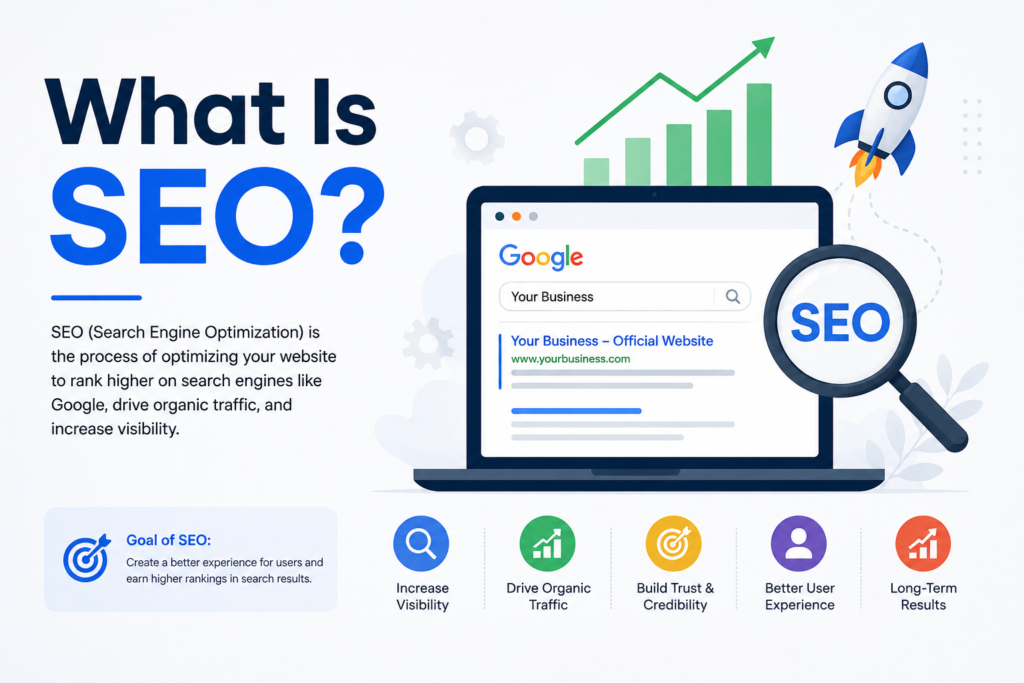
Introduction When people need an answer, product, service, restaurant, doctor, agency, or local business, one of the first places they often go is Google. But have you ever wondered why some websites appear at the top of Google while others appear on the second, third, or tenth page? One important reason is SEO — Search Engine Optimization. SEO is the process of improving a website and its content so that search engines can better understand it and users can discover it through relevant searches. What Is SEO? SEO stands for Search Engine Optimization. In simple language, SEO means improving your online presence so that your website has a better opportunity to appear in relevant organic search results. For example, suppose you run a digital marketing agency. A potential customer searches for “digital marketing agency in Kolkata.” If your website is optimized for relevant searches and Google considers it useful and trustworthy, your website may appear in the search results. Unlike paid advertising, organic SEO traffic does not require you to pay Google for every click. Why Is SEO Important? People usually use search engines when they are looking for information or solutions. This creates an opportunity for businesses. If your website appears when potential customers search for products or services you offer, you can attract relevant visitors. SEO can help businesses: However, SEO is not an overnight strategy. It generally requires time, consistency, quality content, and technical improvements. How Does Google Decide Which Website Ranks? Google uses sophisticated systems to determine which pages should appear for different searches. There is no single factor that guarantees a top position. Google considers many signals related to relevance, quality, usability, content, links, and other aspects. This is why SEO is much more than simply adding keywords to a webpage. The Main Areas of SEO 1. On-Page SEO On-page SEO involves optimizing elements on your website. This can include: The goal is to make pages useful for both search engines and people. 2. Technical SEO Technical SEO focuses on the technical foundation of a website. It can include: A technically strong website makes it easier for search engines to access and understand content. 3. Off-Page SEO Off-page SEO refers to activities outside your website that can influence its authority and reputation. Backlinks are one example. A backlink occurs when another website links to your website. However, not all backlinks are equally valuable. Quality and relevance matter more than simply collecting a large number of links. What Are Keywords? Keywords are words or phrases people type into search engines. For example: “best SEO agency” “Google Ads agency” “digital marketing services” “interior designer near me” Keyword research helps businesses understand what potential customers are searching for. But modern SEO should not be based on repeatedly inserting keywords into content. The content should answer the user’s question naturally. Search Intent Search intent is another important part of SEO. Consider these searches: “What is SEO?” “SEO agency near me” “SEO services pricing” “hire SEO company” They may all relate to SEO, but the intent is different. The first person wants information. The second may be looking for a local service provider. The third is researching pricing. The fourth may be ready to hire someone. Good SEO content considers what the searcher actually wants. SEO vs Google Ads SEO and Google Ads are different. Google Ads can provide paid visibility, while SEO focuses on organic search visibility. Google Ads can potentially generate traffic quickly after a campaign is launched. SEO generally takes longer to develop but can create a valuable long-term source of organic traffic. Many businesses use both. Paid advertising can help generate immediate opportunities, while SEO builds organic visibility over time. Common SEO Mistakes Some common mistakes include: SEO should be treated as a long-term investment rather than a quick trick. How Long Does SEO Take? There is no universal timeline. Results can depend on competition, website history, technical condition, content quality, industry, authority, and search demand. A new website competing in a highly competitive industry may need considerable time. A well-established website targeting a less competitive search may see improvements sooner. Therefore, anyone promising guaranteed first-page rankings within a fixed short period should be treated carefully. Final Thoughts SEO is fundamentally about helping search engines understand your website while providing real value to users. Successful SEO is not about manipulating Google. It is about creating a website that is useful, accessible, relevant, trustworthy, and technically sound. For businesses that want sustainable online visibility, SEO can become an important part of their digital marketing strategy. The goal is not simply to rank. The real goal is to attract the right people and turn relevant search traffic into meaningful business opportunities.

What Is SEO? A Beginner-Friendly Guide to Search Engine Optimization Read Post »

Blogs

Digital Marketing vs Performance Marketing: What Is the Difference?

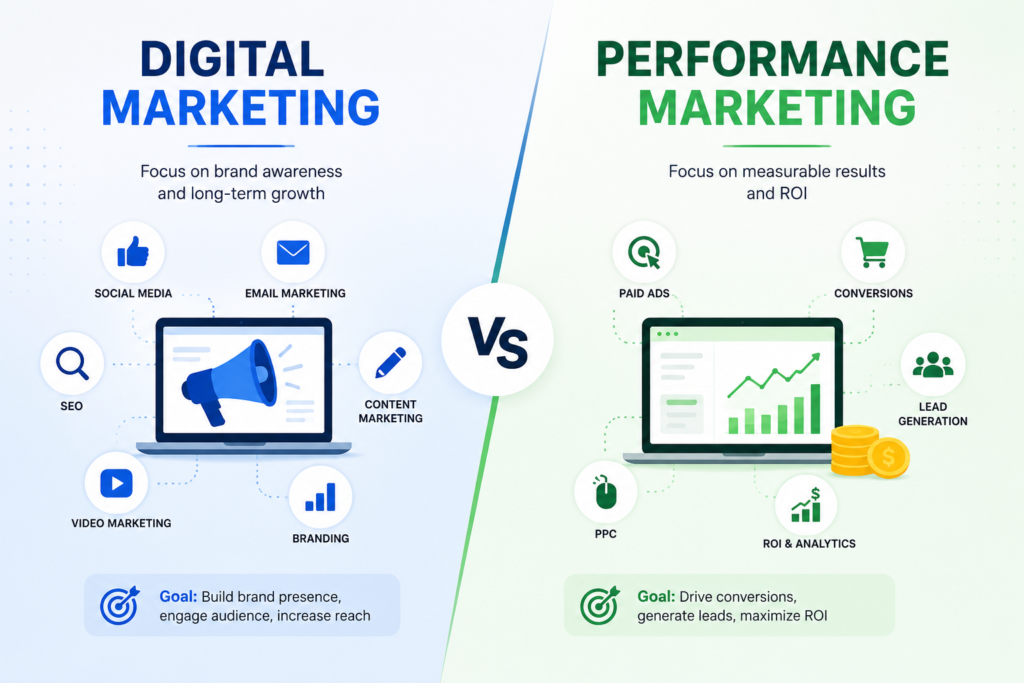
Introduction Digital marketing and performance marketing are terms that are often used interchangeably. Many business owners hear both terms and wonder whether they mean the same thing. They are closely related, but they are not identical. The easiest way to understand the difference is this: Digital marketing is the bigger umbrella. Performance marketing is a results-focused approach within digital marketing. Understanding this difference can help businesses choose the right strategy for their goals. What Is Digital Marketing? Digital marketing refers to marketing activities performed through digital channels. These can include: The objective can vary. A business might use digital marketing to build awareness, increase website traffic, generate leads, improve brand visibility, or increase sales. What Is Performance Marketing? Performance marketing focuses strongly on measurable actions. These actions could include: For example, a company running Google Ads may monitor how many enquiries are generated and how much each enquiry costs. That is a performance marketing approach. The Main Difference The key difference is scope and focus. Digital marketing is a broad field. Performance marketing is more focused on measurable performance and business outcomes. Think of digital marketing as a large toolbox. Inside that toolbox are different tools such as SEO, social media, content marketing, Google Ads, and Meta Ads. Performance marketing is more like a method of using some of those tools with strong emphasis on measurable results. Simple Example Imagine you own a restaurant. You create Instagram posts showing your food. You publish blogs about your menu. You improve your Google Business Profile. You create videos for YouTube. You run Google Ads. All of these can be part of your digital marketing strategy. Now suppose you run an advertising campaign specifically to generate table reservations. You track: That campaign is being managed from a performance marketing perspective. Difference in Goals Digital marketing may have several goals. For example: Performance marketing generally gives greater priority to measurable actions. For example: Difference in Measurement Measurement is one of the biggest differences. Digital marketing can include metrics such as website traffic, followers, engagement, impressions, search rankings, and brand reach. These metrics can be valuable. However, performance marketing typically connects metrics more directly with conversions and business outcomes. For example, getting 100,000 impressions sounds good. But if the campaign produces no enquiries or sales, the business may not consider it successful. Does Digital Marketing Focus on Branding? Yes. Digital marketing can be strongly focused on branding. For example, a company may create educational content for several months to establish expertise. The immediate return may not be easy to measure. But the content can build trust and recognition over time. Performance marketing, on the other hand, usually places stronger emphasis on measurable actions. This does not mean performance marketing ignores branding. In reality, strong branding can improve advertising performance because people are more likely to trust businesses they recognize. Which One Is Better? There is no universal winner. It depends on the business objective. If a new company wants to establish itself in the market, a broader digital marketing strategy may be useful. If a company wants immediate lead generation or ecommerce sales, performance marketing may receive greater priority. In many cases, the best approach is to use both. Digital Marketing and Performance Marketing Can Work Together Consider an interior design company. The company can use SEO to rank for relevant searches. It can publish blogs about home interiors. It can showcase projects on Instagram. It can create videos. At the same time, it can run Google Ads and Meta Ads to generate enquiries. The organic activities build visibility and trust. The paid campaigns can generate measurable opportunities. Together, they create a stronger marketing ecosystem. Common Misunderstanding One common mistake is assuming that performance marketing means “getting cheap leads.” Cheap leads are not necessarily good leads. Suppose one campaign generates leads at ₹200 each, but most leads are irrelevant. Another campaign generates leads at ₹600 each, but those leads regularly become paying customers. The second campaign may actually be more valuable. Therefore, businesses should measure the quality and value of conversions, not just the cost. When Should a Business Use Digital Marketing? Digital marketing is useful for businesses that want to build a sustainable online presence. It is particularly valuable for: When Should a Business Focus on Performance Marketing? Performance marketing can be particularly useful when a business has a clear measurable objective. Examples include: It works especially well when proper conversion tracking is available. Final Thoughts Digital marketing and performance marketing should not be viewed as competitors. Digital marketing is the broader discipline, while performance marketing is a results-oriented approach that operates largely within it. A successful business may need both. Digital marketing helps build visibility, trust, and presence. Performance marketing helps turn marketing activity into measurable actions and business results. The right balance depends on your business model, target audience, budget, competition, and objectives.

Digital Marketing vs Performance Marketing: What Is the Difference? Read Post »

Blogs

What Is Performance Marketing? A Simple Guide for Businesses

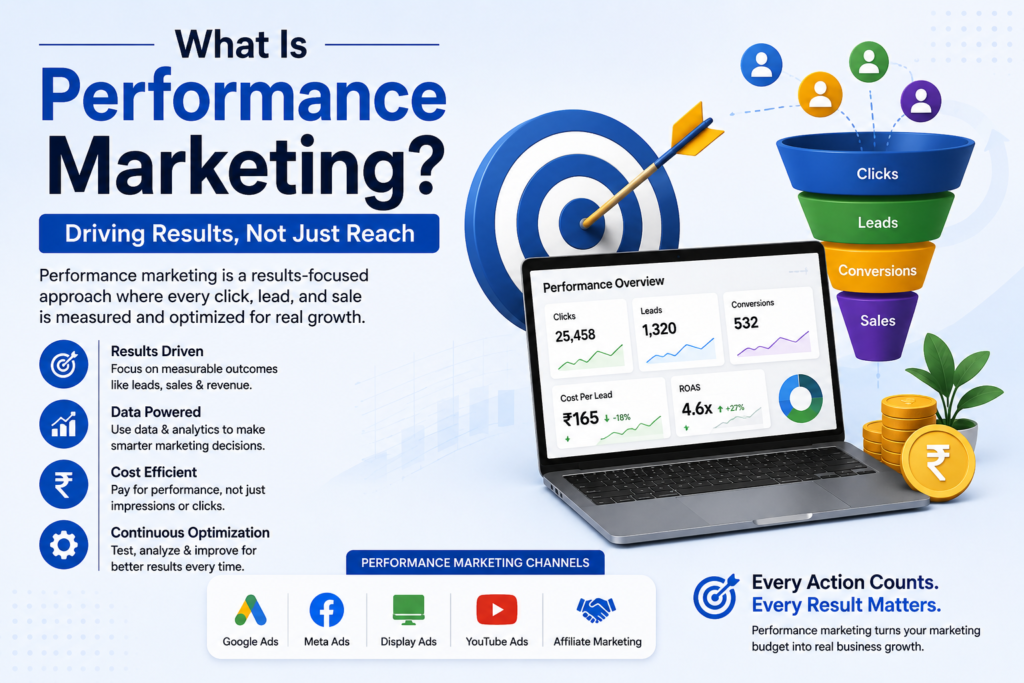
Introduction Every business wants results from its marketing. Getting thousands of views or impressions may look impressive, but business owners usually want something more meaningful: enquiries, leads, sales, customers, and revenue. This is where performance marketing becomes important. In simple terms, performance marketing is a form of digital marketing where campaigns are planned, tracked, and optimized around measurable actions. Instead of focusing only on visibility, performance marketing asks a more practical question: “What did the marketing campaign actually achieve?” What Is Performance Marketing? Performance marketing is a results-focused approach to online marketing. The desired result can be different depending on the business. For an interior designer, the goal might be qualified enquiries. For an ecommerce company, the goal might be purchases. For a software company, it could be free trials or demo bookings. For a coaching business, it might be consultation bookings. Therefore, performance marketing is not about one specific platform. It is about measuring marketing activity against business outcomes. How Does Performance Marketing Work? Let’s take a simple example. Suppose a real estate company spends ₹50,000 on online advertising. During the campaign, the company receives 200 enquiries. The marketing team can then analyse: This information helps the business understand whether the campaign is actually contributing to growth. Common Performance Marketing Channels Performance marketing can use several digital channels. Google Ads Google Ads is one of the most popular performance marketing channels. Businesses can target people searching for specific products and services. For example, someone searching for “best digital marketing agency in Kolkata” already has some level of intent. A relevant advertisement can put a business in front of that potential customer at the right moment. Meta Ads Meta Ads can help businesses reach people through platforms such as Facebook and Instagram. Businesses can target audiences based on various characteristics and campaign objectives. Meta Ads can be particularly useful for generating demand, promoting products, collecting leads, and remarketing. Display Advertising Display campaigns use visual advertisements across websites and digital properties. They can be useful for awareness, remarketing, and reaching relevant audiences. Affiliate Marketing In affiliate marketing, partners promote a business’s products or services and receive compensation based on agreed results. This can create a performance-oriented relationship between the advertiser and the affiliate. Important Performance Marketing Metrics Performance marketing relies heavily on data. Some common metrics include: Cost Per Click (CPC) CPC tells you how much you are paying, on average, for a click. Cost Per Lead (CPL) CPL tells you how much it costs to generate a lead. Conversion Rate Conversion rate shows the percentage of users who complete a desired action. Return on Ad Spend (ROAS) ROAS compares revenue generated from advertising with advertising expenditure. For example, if a business spends ₹10,000 on advertising and generates ₹40,000 in tracked revenue, the ROAS is 4x. However, revenue alone does not always tell the complete story because profit margins, operational costs, and customer lifetime value also matter. Why Is Performance Marketing Important? One major benefit is accountability. Businesses can track campaigns and make decisions based on data instead of assumptions. Suppose Campaign A generates leads at ₹300 each while Campaign B generates leads at ₹800 each. At first glance, Campaign A appears better. But what if Campaign B produces much higher-quality leads that convert into customers more frequently? This is why performance marketing should not focus on one metric alone. The real goal is to connect marketing data with business results. Performance Marketing vs Traditional Advertising Traditional advertising often focuses on exposure. For example, a billboard may be seen by thousands of people, but measuring exactly how many viewers became customers can be difficult. Digital performance marketing offers much more detailed tracking. Businesses can often see impressions, clicks, conversions, costs, and other campaign data. This does not mean traditional advertising is ineffective. It simply means performance marketing provides a different level of measurability. Is Performance Marketing the Same as Digital Marketing? No. Performance marketing is a part of the larger digital marketing ecosystem. Digital marketing can include SEO, content marketing, branding, social media, email marketing, websites, paid advertising, and more. Performance marketing puts greater emphasis on measurable actions and outcomes. A company may use digital marketing to build its brand while using performance marketing to generate leads and sales. Both can work together. The Importance of Landing Pages Advertising alone does not guarantee results. Imagine a business receives 1,000 clicks from an advertisement but has a confusing website. Visitors may leave without contacting the company. This is why landing pages are important in performance marketing. A good landing page should clearly communicate: The advertisement gets the visitor’s attention. The landing page helps convert that attention into action. Performance Marketing Requires Continuous Optimization A campaign should not simply be launched and forgotten. Marketers should regularly analyse the data. They may test different: Small improvements can sometimes make a meaningful difference in campaign performance. Final Thoughts Performance marketing is about making marketing more measurable and accountable. Instead of asking only how many people saw an advertisement, businesses can ask how many people clicked, submitted an enquiry, purchased, or became customers. However, performance marketing is not a magic formula. Good results require the right strategy, targeting, creative, offer, landing page, tracking, and continuous optimization. The ultimate objective is not simply to generate cheap clicks or cheap leads. The objective is to generate valuable business results.

What Is Performance Marketing? A Simple Guide for Businesses Read Post »

Blogs

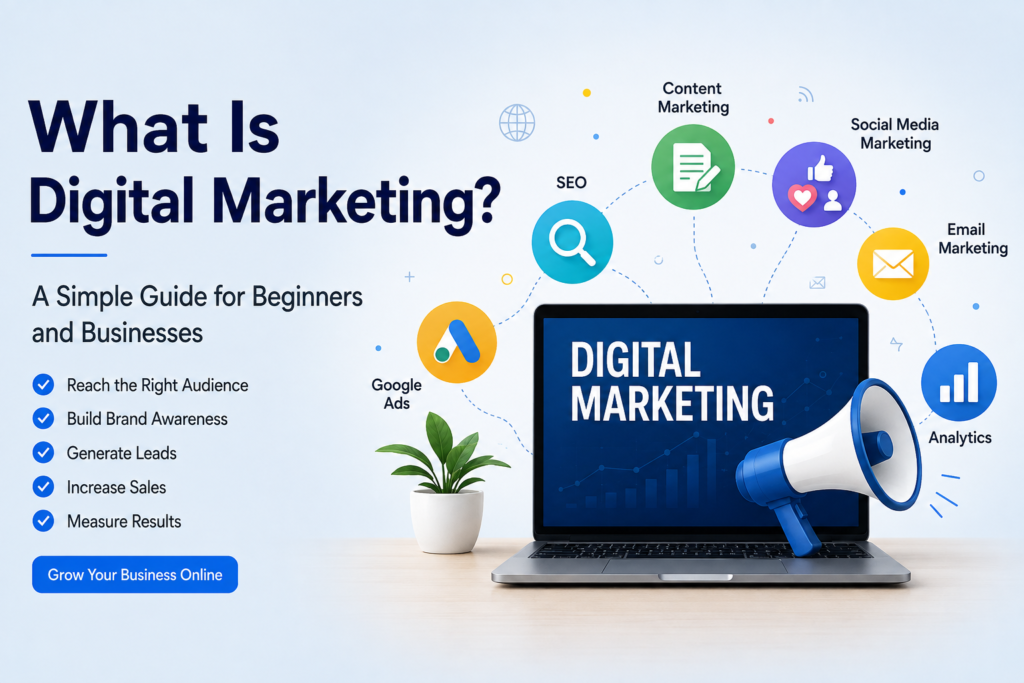
What Is Digital Marketing? A Simple Guide for Beginners and Businesses

Introduction The way people discover and choose businesses has changed dramatically. A few years ago, people mainly depended on newspapers, television, banners, referrals, and traditional advertisements to find products and services. Today, most people start their search online. Whether someone wants to find a restaurant, buy a phone, hire an interior designer, book a hotel, or choose a digital marketing agency, there is a good chance they will search online first. This is where digital marketing comes in. In simple words, digital marketing means promoting a business, product, or service using the internet and digital channels. These channels can include Google, social media platforms, websites, email, search engines, online advertisements, and more. For businesses, digital marketing is no longer just an additional marketing option. It has become an important part of reaching potential customers. What Exactly Is Digital Marketing? Digital marketing is the process of using digital platforms to reach, attract, engage, and convert potential customers. For example, imagine that you own an interior design company in Kolkata. A person searches Google for “best interior designer near me.” If your website appears in the search results, that is digital marketing. If the same person sees your interior design advertisement on Instagram, that is also digital marketing. If they receive an email from your company offering a consultation, that is digital marketing too. So, digital marketing covers many different activities rather than being a single marketing method. Major Types of Digital Marketing There are several important areas of digital marketing. 1. Search Engine Optimization (SEO) SEO helps a website appear higher in search engine results organically, without paying for every click. For example, if you provide website development services and your website ranks for “website development company in Kolkata,” people can discover your business through Google. SEO generally involves content, keywords, technical improvements, website structure, backlinks, and user experience. 2. Google Ads Google Ads allows businesses to advertise on Google’s search results and other Google properties. Suppose someone searches for “Google Ads agency near me.” A business can run an advertisement that appears when people search for relevant terms. The major advantage is that businesses can reach people who are already showing interest in a particular product or service. 3. Social Media Marketing Platforms such as Facebook, Instagram, LinkedIn, and YouTube allow businesses to connect with their audiences. Social media marketing can include organic posts, videos, reels, educational content, community engagement, and paid advertising. It is particularly useful for building awareness, trust, engagement, and brand recognition. 4. Content Marketing Content marketing means creating useful information that attracts and educates potential customers. Examples include blogs, videos, guides, infographics, case studies, and social media posts. Instead of simply saying “buy our service,” content marketing answers the questions customers have before making a purchase. 5. Email Marketing Email marketing involves communicating with customers and prospects through email. Businesses can use email to share offers, newsletters, product updates, educational content, and important information. 6. Performance Marketing Performance marketing focuses strongly on measurable results such as leads, sales, conversions, or revenue. For example, instead of simply measuring how many people saw an advertisement, a business may focus on how many qualified leads were generated from that advertisement. Why Is Digital Marketing Important? One of the biggest advantages of digital marketing is reach. A local business can reach people in its city, while an ecommerce company can reach customers across the country or even internationally. Digital marketing also allows businesses to understand their audiences better. For example, advertising platforms can provide information about impressions, clicks, conversions, cost per lead, and other performance metrics. This information helps businesses understand what is working and what needs improvement. Another advantage is flexibility. Traditional advertising can sometimes require a significant upfront investment. Digital campaigns can often be started with smaller budgets and adjusted based on performance. Digital Marketing Is Not Just About Advertising A common misunderstanding is that digital marketing simply means running advertisements. Advertising is only one part of digital marketing. A successful digital marketing strategy may include SEO, content, social media, Google Ads, Meta Ads, email marketing, website optimization, and conversion optimization. Imagine a customer sees your Instagram advertisement but does not purchase immediately. Later, they search your company on Google and visit your website. They read your blog, check your reviews, look at your services, and finally contact you. Several digital marketing activities may have contributed to that single customer. How Does Digital Marketing Help a Business? Digital marketing can help businesses: However, digital marketing does not guarantee success simply because a business is present online. Strategy matters. A business needs the right audience, the right message, the right platform, good creative content, a useful website, and proper measurement. Digital Marketing for Small Businesses Digital marketing is especially valuable for small businesses. A small business does not necessarily need to compete with a large company by spending more money. Instead, it can focus on a specific audience or location. For example, a local dentist could target people searching for dental services within a particular city or area. An interior designer could showcase completed projects through Instagram while using Google Ads to target people actively searching for interior design services. The key is to understand where potential customers spend their time and what they are looking for. Final Thoughts Digital marketing is essentially about meeting customers where they already spend their time — online. It combines different strategies such as SEO, Google Ads, social media, content marketing, email marketing, and performance marketing to help businesses attract and convert customers. The best digital marketing strategy is not necessarily the one using the most platforms. It is the one that understands the target audience and uses the right channels to achieve specific business goals. For a business owner, the most important question is not simply, “Should I do digital marketing?” The better question is: “Which digital marketing strategy can help my business reach the right customers and achieve measurable growth?” That is where a well-planned digital marketing strategy can make

What Is Digital Marketing? A Simple Guide for Beginners and Businesses Read Post »

Shopping Cart
Scroll to Top